Thursday, October 20, 2005

In Memory of Datin Seri Paduka Endon Mahmood


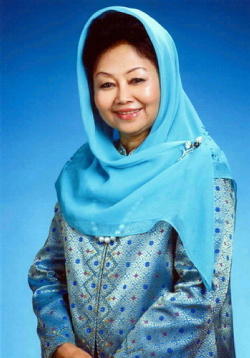
Today Malaysia loses her First Lady Datin Seri Paduka Endon Mahmood her demise will be a great loss to the local Malaysian arts and culture scene.

Datin with her passion for local handicrafts and traditions, has taken it upon herself to revitalise pride in Malaysian crafts, both locally and internationally.

http://www.batikguild.com/main.php


She launched the Nyonya Kebaya - A Showcase exhibit in Kuala Lumpur in 2003. It was her hope that the exhibition and book will raise the awareness of the unique aspects of the cultural heritage of the Peranakans and inspire Malaysian designers and artist.

Currently her collection is on loan to The Asian Civilisation Museum (Singapore) from 9/3/2004 to 29/5/2005.

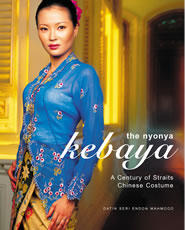
DATIN also wrote a book The Nyonya Kebaya: Century of Straits Chinese Costume
KUALA LUMPUR, Malaysia (AP)

Prime Minister Abdullah Ahmad Badawi's wife, whom he described as his No. 1 supporter, died Thursday after a nearly four-year battle with breast cancer. She was 64.

Endon Mahmood's death -- which comes less than two months after she and Abdullah marked their 40th wedding anniversary -- is the biggest personal blow to the Malaysian leader since he took office in October 2003 following the retirement of his predecessor, longtime leader Mahathir Mohamad.

Endon, who recently underwent months of intensive chemotherapy in Los Angeles, passed away at the family's official residence Thursday morning in Putrajaya, Malaysia's administrative capital, after being released from a Malaysian hospital Monday, said Abdullah's spokeswoman, Esuriyanti Ahmad.

"The family members were at her side, everybody was there," Esuriyanti said, adding that Endon would be buried in a traditional Muslim funeral later Thursday.

Abdullah, Malaysia's fifth prime minister since the country achieved independence from Britain in 1957, had been married to Endon since September 4, 1965. They have a son, a daughter and four grandchildren.

Abdullah has often publicly called Endon his "No. 1 supporter."

When his mother died of natural causes in February 2004, Abdullah telephoned Endon in the United States, where she was undergoing treatment. She later told reporters that he said: "I've lost my mother and I don't want to lose you too."

Endon discovered she had breast cancer in 2002 following a checkup after her twin sister, Noraini, was earlier diagnosed with the disease.

Monday, October 10, 2005

Tan Cheng Lock Baba House

When I saw this report in The Straits Times on Saturday 8/10/2005. I was so happy as this is something that will take Peranakan culture out of the museum if the initial plans are follow through.

$5.5 million (Singapore Dollars) was given to NUS(National University of Singapore) but with an unusual request that the money is use to acquire Peranakan homes in Singapore and Malacca.

This request came from the last surviving daughter of the late Tun Tan Cheng Lock founder of Malaysian Chinese Association (MCA). Miss Agnes Tan who is 85 years old asked that NUS acquire a Peranakan house at Neil Road and two more houses at Jalan Tun Tan Cheng Lock in Malacca.

The house in Singapore will be used to teach young Singaporean about Peranakan history, culture and tradition and will be named the Tan Cheng Lock Baba House while the other two houses in Malacca costing S$1.5 million will be restored and use for to study subjects such as the conservation techniques of historical bulidings.

The house acquired at Neil Road belongs is one of the last remaining authentic homes which belong to a Peranakan Wee Lin an engineer whose ancestor is Wee Bin who was a shipping tycoon. Plans include having a Bibik impersonator as a live-in housekeeper and also into making the house a centre for exhibitions, talks and performances and to include the Wee family history.

Monday, September 19, 2005

The Peranakan Experience: A Singapore Story

In 2003 the inaugural lecture for the Lien Fung’s Colloquium - Chakap Chakap lah :-) was held at the Singapore Management University visit the link to see, hear all about The Peranakan Experience.

You can hear old and new Malay/Peranakan/English songs like Tanjong Katong, Rasa Sayang, Chan Mali Chan, Burong Kakak Tua, Su Suay Kemuning, Aiyoh Mama, Oleh Oleh Bandung, Nyonya Nyonya, Nyonya Pakey Bunga, Nyonya Manis and many more which are old favourites of the Peranakans.

http://www.smu.edu.sg/oaa/events_031128.asp

Friday, September 09, 2005

Wayang Peranakan

Wayang Peranakan started from the influence of the Malay Bangsawan (Malay Opera) trying to ascertain the time period as to when it all started would be difficult. Bangsawan rose to popularity in the Straits Settlements (Singapore, Malacca & Penang) , Malaya (Malaysia) and the Dutch East Indies (Indonesia) from the 1880's (Bangsawan: A Social and Stylistic History of Popular Malay Opera by Tan Sooi Beng - Oxford Unversity Press, 1993) As the Peranakans enjoy watching the Bangsawan naturally given time they adapted it and started producing thier very own Wayang Peranakan.

Wayang Yap Chow Thong and Opera Stamboul could have been the earliest owned Chinese bangsawan troupes as press advertisements were found in the local papers Straits Echo as far back as May 1904.

With its popularity many groups were formed such as the Wales Minstrels Party, Merrilads Musical Party(1930's), Oleh Oleh Party (Jan 1932), and Kumpulan Peranakan Singapura, staging musical shows, music, song, dance and drama became a part of our vibrant culture.

The themes of the wayang centre around the family. Domestic squabbles, matriarchal domination and young love which are spun in a web of intrigue with surprising twists and turns of the plot, and finally concluding with a happy ending. Using local humour and the quick wit of the performers injecting comedy and drama, the Peranakan stories and characters often mirror and amplified the real life off stage. Tidak Berdosa, Rusia, Kaseh Ibu Tiri, Nyai Dasima, and Naseb Si Buta are some of the popular old plays.

By the 1960's all this came to an end there was almost a 20 years wait until Felix Chia's Pileh Menantu (Choosing a Daughter in law) was staged in 1984 for the Arts Festival. With its sucess a new spark of life was given to Wayang Peranakan. And from then on Gunung Sayang Association produce a play each year.

In 2001 in celebration of its 100th Anniversary the Peranakan Association presents Dah Sa Chupak Tak Boleh Sa Gantang. In 2002 a totally new style of Wayang Peranakan was produced by the Association titled Bibik Behind Bars (All about Bibiks and thier foundness of playing Cherki).The play was even recorded and telecast on TV at Arts Central Channel. In its resounding sucess Bibiks Goes Broadway was produce.

In 2005 The Main Wayang Company was founded and it makes its debut performance Bibiks In Parliament and in October 2005 they will will be staging Bibik Chari Menan 2. Main Wayang also produce Music CD's and VCD's of thier past productions.

Past Plays by Gunung Sayang Association (VCD's of past productions available for sale)

1985 - Buang Keroh Pungot Jernih (Let Bygones Be Bygones)
1986 - Lepas Jambatan Buang Tongkat (The Ingrate)
1986 - Menyasal (Regrets)
1987 - Zaman Sekarang (Times Have Changed)
1989 - Biji Mata Mak (Apple Of His Mother Eyes)
1990 - Tak Sangkah (Unexpected)
1990 - Sudah Di Janji (Fated)
1992 - Nasib (Fate)
1993 - Salah Sangkah (Misunderstood)
1995 - Manis Manis Pait (Bitter Sweet Memories)
1996 - Kalau Jodoh Tak Mana Lari (Destiny of Love)
1997 - Bulan Pernama (An Auspicious Full Moon)
1999 - Janji Perot (Pre-Birth Pact)
2000 - Cheh It Chap Goh (Every Cloud Has A Sliver Lining)
2001 - Hujan Balek Ka Langit (The Impossible)
2002 - Anak Udang Anak Tenggiri (Blood Is Thicker Than Water)
2003 - Kipas Cendana (The Sandalwood Fan)
2004 - Buang Keroh Pungot Jernih (Let Bygones Be Bygones)
2005 - Belom Mati Belom Tau (The Unpredictable)

Thursday, September 08, 2005

Belom Mati Belom Tau - Gunung Sayang Association Wayang Peranakan 2005


Belom Mati Belom Tau

Its the time of the year again when Gunung Sayang Association produce its annual Wayang Peranakan stage at The Victoria Theatre this year production titled Belom Mati Belom Tau.The playwright GT Lye will provide the audience with a glimpse into a typical Peranakan household of the 60s. Also anthroplology affcionados will get a glimpse how Peranakans of the old days mourn their love ones, along with the fashion and culture of their time.

The poster of the play shows a black and white sarong worn during mourning periods also pearl kerosangs and silver chocok sanggul (chignon hair pins).


Press Review for Belom Mati Belom Tau

A Peranakan's progress Veteran playwright passes on customs of his culture in his latest play

By Hong Xinyi

PLAYWRIGHT G.T. Lye finds himself getting nostalgic each time the annual drama production put on by Peranakan association Gunong Sayang comes around in September. After all, the stage is about the only place where Peranakan culture is the most vibrant these days, says the renowned female impersonator. For the past 20 years, the 67-year-old has been directing and scripting this annual event, as well as acting in it, for Gunong Sayang. Founded in 1910 to promote Peranakan, or Straits Chinese, culture, the association has put on a Peranakan production every year since 1985.

This year, Lye, a retired businessman, wrote a play titled Belom Mati Belom Tau (You Wouldn't Know Because You're Not Dying). Set in 1960s Singapore, it tells the story of a sickly Peranakan matriarch and her scheming family. Lye, who is also the director, plays the role of the matriarch's eldest daughter-in-law, who tries to hoard the family's wealth. The two-hour-long play will include scenes where the Peranakan rituals of mourning are re-enacted for the audience.

''Peranakan women wear attire of different colours for different phases of the mourning period,'' he elaborates. ''They are also not allowed to wear gold jewellery, and they can't attend weddings, birthdays or any joyous occasion.''

His exhaustive attention to such details is a rarity in the Peranakan community these days.''The younger generation also finds practices like ancestral worship too tedious and time-consuming,'' Lye says, with a tinge of wistfulness in his soft voice. He tries to keep Peranakan culture alive by including such rituals in his plays, and also by ''creating stories where I can educate the younger generation, and remind the older generation of things they have forgotten''.

For Belom Mati Belom Tau, his message, not surprisingly, is the value of filial piety. But in the field of female impersonation, at least, the bachelor need not be worried. Kelvin Tan, a Peranakan, has been learning the ropes from Lye for the past three years, and the latter pronounces the 36-year-old quite a competent successor. ''It was rather rough in the beginning to get the hand movements and way of speaking right,'' says Tan, a civil servant. But what keeps him going, he says, is his fascination with the play's recreation of a 1960s Peranakan lifestyle. ''It gives me a chance to experience an era I never had a chance to live in,' says Tan.'' It's really an eye-opening experience, and it gives all of us from the younger generation a lot of pleasure.